Last Updated: February 2026
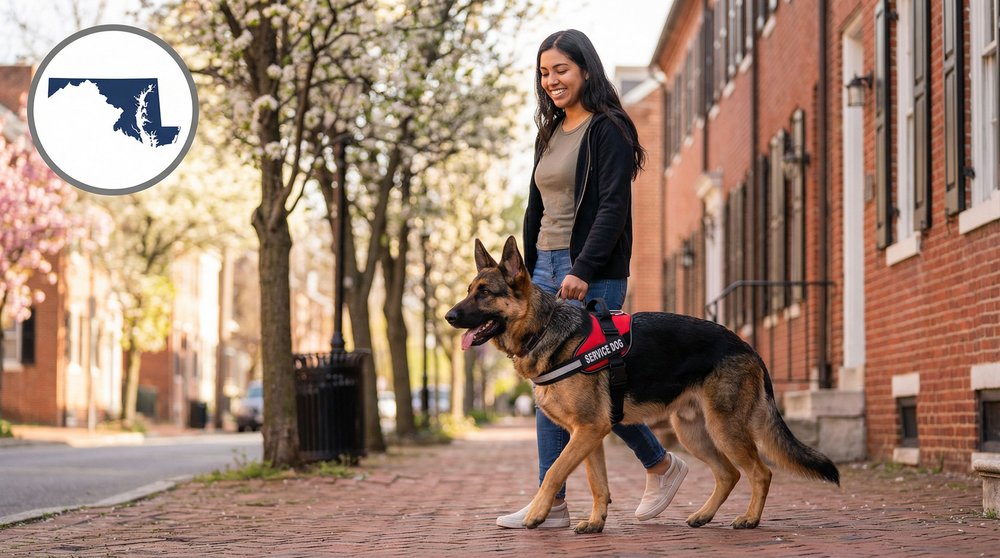
Maryland provides comprehensive protections for service dog handlers through a combination of federal ADA coverage and detailed state statutes spread across multiple articles of the Maryland Code. The state is notable for its orange tag licensing system for service dogs, a retired service dog housing provision that lets handlers keep retired service dogs for life, and the 2021 criminal statute (Crim. Law § 10-626) that punishes harming service animals with up to 2 years imprisonment.
Whether you’re a current service dog handler or training your own service dog in the Old Line State, this guide covers everything you need to know about your rights and protections under Maryland law.
Federal ADA Protections in Maryland
The Americans with Disabilities Act (ADA) applies fully in Maryland. Under the ADA (42 U.S.C. §§ 12101–12213), a service animal is defined as a dog that is individually trained to do work or perform tasks for the benefit of an individual with a disability.
Examples of tasks include:
- Guiding a person who is blind
- Alerting a person who is deaf to sounds
- Pulling a wheelchair
- Alerting and protecting a person during a seizure
- Reminding a person with mental illness to take medication
- Calming a person with PTSD during an anxiety attack
- Interrupting self-harm behaviors
Important: Emotional support animals, comfort animals, and therapy animals are not considered service animals under the ADA because they haven’t been trained to perform a specific task.
Maryland’s Service Animal Statutes
Maryland’s service animal protections are spread across several articles of the Maryland Code, with the primary statute being the Human Services Code, Title 7, Subtitle 7 (Hum. Servs. §§ 7-701 through 7-709).
Hum. Servs. § 7-701 — Definitions
Maryland defines a “service animal” as a guide dog, signal dog, or other animal individually trained to do work or perform tasks for the benefit of an individual with a disability, including:
- Guiding visually impaired persons
- Alerting deaf individuals to sounds
- Providing rescue work
- Pulling wheelchairs
- Fetching items
- Detecting seizure onset
Notable: Maryland’s definition says “other animal” rather than limiting to dogs. This is broader than the federal ADA’s definition, though in practice most public accommodations follow ADA standards (dogs and miniature horses only).
Hum. Servs. § 7-704 — Public Access Rights
Individuals with disabilities, parents of minor children with disabilities, and service animal trainers have the same right as individuals without disabilities to:
- Full and free use of roads, sidewalks, public buildings, public facilities, and other public places
- Full and equal access to common carriers, public conveyances, and places of public accommodation
- Equal access to housing accommodations statewide
No extra compensation may be charged for the service animal, though the handler may be liable for damages caused by the animal.
Service Dogs in Training (SDITs)
Maryland grants public access rights to service dogs in training. Under Hum. Servs. § 7-705(c), a service animal trainer may be accompanied by an animal being trained as a service animal in any place of public accommodation, except where the animal would create a “clear danger of a disturbance or physical harm.”
This is a valuable provision, though the exception for “clear danger” gives businesses slightly more discretion than some states allow for SDITs. The trainer remains responsible for the animal’s behavior and training organizations may be held responsible for injuries or facility damage caused by animals in training.
The Orange Tag System
Maryland has a distinctive orange identification tag system for service dogs, established under Local Gov’t § 13-104:
- Service dogs receive a special orange license tag in addition to any standard tag
- The license is inscribed with “service dog” in red ink
- Service dogs are exempt from all licensing fees
- Owners must sign an affidavit that the dog has been professionally trained
Important: While the orange tag is part of Maryland’s system, the law explicitly states that failure to use a service animal wearing an orange tag or collar does not constitute contributory negligence. The tag is an identification tool, not a requirement for access rights.
The Two-Question Rule
When it’s not obvious what service a dog provides, businesses may ask only two questions:
- “Is this a service animal required because of a disability?”
- “What work or task has the dog been trained to perform?”
Staff cannot:
- Ask about the nature or extent of the person’s disability
- Require documentation, certification, ID cards, or special vests
- Ask the dog to demonstrate its task
- Charge extra fees or surcharges for the service dog
Where Service Dogs Are Allowed
Under both the ADA and Maryland’s Human Services Code, service dogs are permitted in all places of public accommodation, including:
- Restaurants, cafes, and bars
- Retail stores and shopping malls
- Hotels, motels, and lodging places
- Hospitals and medical offices
- Theaters and entertainment venues
- Government buildings
- Schools, colleges, and universities
- Public transportation
- Parks and recreational areas
- Maryland Stadium Authority facilities
A service dog may only be excluded if it is out of control, not housebroken, or poses a direct threat.
Housing Rights
Federal Fair Housing Act (FHA)
The FHA (42 U.S.C. §§ 3601–3619) requires landlords to make reasonable accommodations for assistance animals, including service dogs, even in “no pets” housing. No pet deposits or fees may be charged.
Maryland State Housing Protections (State Gov’t § 20-706)
Maryland’s state housing law was significantly updated by SB 535 (2023), effective October 1, 2023. Key protections for service dog handlers include:
- Lease exemption: Service dogs are exempt from any lease provision prohibiting dogs
- No fees: Cannot be required to pay additional rent or fees for the service dog
- Reasonable accommodation: Landlords may not refuse reasonable accommodations
- The handler remains liable for property damage caused by the service dog
Retired Service Dog Provision (Unique to Maryland)
One of Maryland’s most distinctive provisions: a handler may keep a former/retired service dog in their dwelling for the life of the dog after it retires from service. No additional rent or fees may be charged for the retired service dog, and the handler remains liable for any damage caused.
This humane provision recognizes the deep bond between handlers and their service dogs and prevents the forced separation of a handler from an aging companion who has served them for years.
Employment Protections
Federal ADA
Title I of the federal ADA covers employers with 15 or more employees and requires reasonable accommodations for employees with disabilities, which can include allowing a service dog in the workplace.
Maryland Fair Employment Practices (State Gov’t § 20-606)
Maryland prohibits disability discrimination in employment and requires employers to make reasonable accommodations. This can include allowing a service dog in the workplace. The Maryland Commission on Civil Rights (MCCR) enforces these provisions.
Registration and Identification Accessories
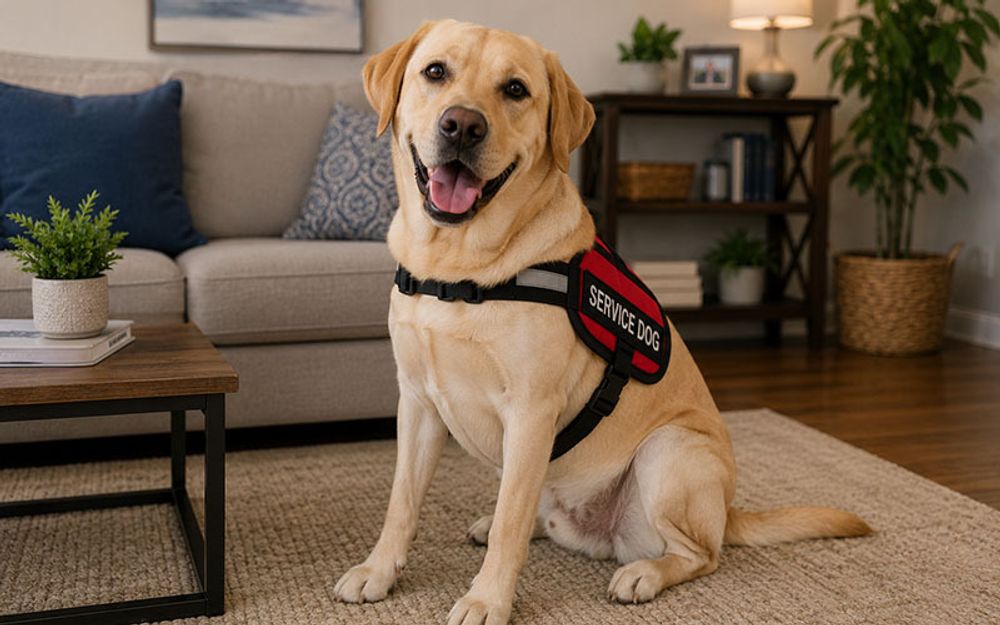
While registration, ID cards, vests, leashes, tags, and other identification accessories are not required or endorsed by the ADA, they serve a practical purpose — much like a uniform. Outfitting your service dog with identifiable gear allows people to recognize them as a working animal from a distance, reduces hassle and questioning in public, and helps create a smoother experience for both handlers and businesses.
Think of it as a courtesy that benefits everyone. When your service dog is wearing a clearly marked vest or harness, store employees and other patrons are less likely to approach with questions or attempt to pet your dog. This means fewer interruptions while your service dog is working and a more seamless experience in restaurants, stores, and other public places.
Common service dog accessories include:
- Service dog vests and harnesses — clearly identify your dog as a working animal
- Service dog leashes — printed with “Service Dog” for added visibility
- ID cards and tags — provide quick reference for your dog’s role
- Patch sets — allow you to customize your dog’s vest with relevant messages
Penalties and Enforcement
Denying Service Animal Access (Hum. Servs. § 7-705)
Denying or interfering with the admittance of a service animal is a misdemeanor:
- Trained service animal: Fine not exceeding $500 per offense
- Service animal in training: Fine not exceeding $25 per offense
Individuals also have a private right of action to seek injunctive relief under Hum. Servs. § 7-707.
Harming a Service Animal (Crim. Law § 10-626)
Enacted via HB 234 (2021) and strengthened by HB 667 (2024), this statute provides serious criminal penalties:
| Violation | Max Imprisonment | Max Fine |
|---|---|---|
| Killing or injuring a service animal | 2 years | $2,500 |
| Interfering with use of a service animal | 1 year | $1,000 |
The 2024 HB 667 update added that each animal harmed is a separately chargeable offense and deemed an individual victim for sentencing purposes. Sentences may run consecutively, making this one of the stronger service animal protection laws in the country.
Courts may also order full restitution including the replacement cost of the service animal, retraining costs, and lost wages during the period without a service animal.
Traffic Violations (Transp. § 21-511)
Drivers who fail to yield to a blind pedestrian with a service dog or white cane face a traffic infraction with fines from $50 to $1,000.
White Cane Impersonation
Maryland makes it a misdemeanor for a non-blind person to carry a white or metallic cane in the manner used by blind individuals, punishable by up to a $500 fine.
Service Animal Fraud
Maryland does not have a specific fake service dog statute. It is one of only a handful of states that has not enacted a penalty for misrepresenting a pet as a service animal. As of 2026, approximately 45 states and D.C. have such laws, but Maryland relies on general fraud and trespass provisions instead.
Special Programs
Children’s Service Animal Program (Hum. Servs. §§ 13-4101–13-4106)
Established in 2020, this program provides service dogs, support dogs, and equine therapy for children with trauma histories, PTSD, or developmental disabilities through qualified 501(c)(3) nonprofit organizations. It’s overseen by the Department of Disabilities.
Veterans Service Animal Program (State Gov’t § 9-957)
This program targets veteran suicide prevention through service/support dogs and equine therapy. SB 182 (2025) expanded the program to include spouses and dependents of eligible veterans. Grants of $21,500 are awarded to qualifying nonprofit organizations.
Training Requirements
Under the federal ADA — which applies in Maryland — service dogs do not need to be trained by a professional or certified organization. Owner-training (self-training) is fully permitted.
There is no national or state registry, certification, or licensing requirement. A service dog must:
- Be trained to perform at least one specific task related to the handler’s disability
- Be under the handler’s control at all times
- Be housebroken
- Not pose a direct threat to health or safety
Note: While Maryland’s orange tag system requires an affidavit of professional training, the orange tag is an optional identification tool, not a prerequisite for ADA service dog access rights.
Air Travel
Maryland follows federal law for air travel. As of January 2021, the U.S. Department of Transportation’s final rule (14 C.F.R. Part 382) recognizes only trained service dogs. Key rules:
- Airlines may require handlers to complete a DOT Service Animal Air Transportation Form
- Airlines cannot ban specific breeds of service dogs
- Airlines may limit passengers to two service dogs
- The dog must fit within the handler’s foot space
- Service dogs travel in the cabin at no charge
- Emotional support animals are no longer covered — they’re treated as pets
Key Takeaways
- Maryland’s service animal laws span multiple code articles — with the core public access statute in Hum. Servs. §§ 7-701–7-709 and housing protections in State Gov’t § 20-706.
- The retired service dog provision is unique to Maryland — handlers can keep retired service dogs in their dwelling for the life of the dog.
- The orange tag system is a state-specific identifier — but not wearing one doesn’t affect your access rights or constitute negligence.
- Criminal penalties for harming service animals are strong — up to 2 years imprisonment and $2,500 fine, with each animal a separately chargeable offense (2024 update).
- SDITs have public access rights — with an exception for situations creating a clear danger of disturbance.
- Maryland lacks a fake service dog law — one of only a handful of states without a specific misrepresentation penalty.
- No certification or registration is legally required — owner-training is fully permitted under the ADA.
This article is for informational purposes only and does not constitute legal advice. Laws are subject to change — consult a qualified attorney for specific legal questions.