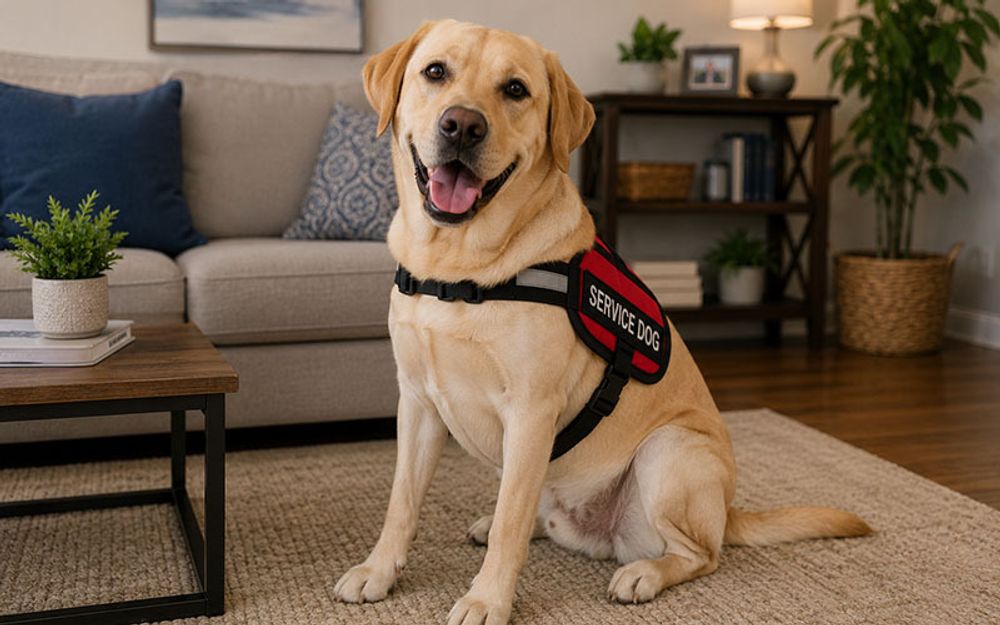
Overcoming "Invisible Disability Imposter Syndrome"
Have you ever felt a surge of guilt standing in front of a “No Dogs Allowed" sign even though your heart was racing? People often downplay their disabilities and think that they are not “disabled enough” because they do not need a wheelchair or a cane. This phenomenon is called “invisible disability imposter syndrome,” and it is extremely common for people who are suffering from invisible conditions.
It should be understood that mental health conditions, as well as chronic pain and neurological disorders, are as relevant as physical ones. This guide is designed to help you feel more confident, understand the legal definition of disability, and clarify what conditions may qualify you for the support you deserve.
The ADA Definition of Disability (Breaking the Stigma)
If you want to move past the guilt of getting a service dog, you can look at how the law defines disability. The ADA (Americans with Disabilities Act) does not provide a master list of every single medical condition. Rather, it uses a functional definition that focuses on the impact a condition has on your life.
Under the ADA, a disability is defined as a "physical or mental impairment that substantially limits one or more major life activities."
Generally, people overlook this phrase: “major life activities.” While we usually think of walking or seeing, the law actually has a much broader range of daily functions that are important for our daily lives. For those with psychiatric or invisible illnesses, these limitations are very real:
➔ Cognitive Function and Focus — When mental fogginess, intrusive thoughts, or executive dysfunction impair the ability to concentrate on tasks related to work, education, or personal security.
➔ Sleeping — When persistent nightmares, hypervigilance, or sleeplessness caused by PTSD or depression interfere with one’s fundamental biological requirement for rest.
➔ Interpersonal Communication and Social Interaction — When debilitating social anxiety, panic disorders, or autism prevent one from functioning in public spaces or interacting with other individuals without experiencing extreme distress.
➔ Emotion Regulation and Self-Care — When mental illnesses such as Bipolar Disorder or Major Depressive Disorder affect one’s capacity to regulate emotions.
If you have a condition that prevents you from going to the grocery store, attending school, or even leaving your house without substantial distress, it is limiting a major life activity. You are not "faking it"; you are navigating a legitimate medical challenge that requires a legitimate solution.
Qualifying for an Emotional Support Animal (ESA)
The use of an Emotional Support Animal is normally one of the first choices for someone struggling with mental well-being. The main advantage of using an Emotional Support Animal isn’t just from what it does, but also its presence. However, ESAs do not have the same public access rights as service dogs under the ADA.
The Requirement
To be eligible for an ESA, there is a specific legal criterion that needs to be met. You will need a recommendation letter from a Licensed Mental Health Professional stating that the animal offers some form of therapeutic value to you. The letter will confirm that your animal companion is a necessary part of your mental well-being.
Common Qualifying Conditions
➔ Generalized Anxiety Disorder (GAD) — When constant worry and physical tension interfere with your daily functions.
➔ Major Depressive Disorder — When a lack of motivation, energy, or hope makes daily tasks feel insurmountable.
➔ Post-Traumatic Stress Disorder (PTSD) — When triggers, flashbacks, or hypervigilance make it difficult to feel safe at home or go about your day. A dog provides a sense of security and grounding that allows a handler to feel safe at home.
➔ Phobias and Agoraphobia — When extreme, irrational fears of places or situations make navigating your environment nearly impossible. A dog can help a handler feel "anchored" enough to manage the anxiety of their environment.
The ESA Medical Benefit
The primary job of an ESA is simply to be there. Scientific studies show that their presence alone lowers cortisol, regulates the nervous system, and provides a necessary routine. For someone struggling to find a reason to get out of bed, the need to care for a dog provides a sense of purpose that can be life-changing.
Qualifying for a Service Dog (and Psychiatric Service Dogs)
The transition from an ESA to a Service Dog (SD) happens when the dog moves from providing comfort to performing tasks. A Service Dog is legally considered a medical tool—no different from a pair of glasses or a wheelchair.
The Requirement
For a dog to be a Service Dog, the ADA requires two things to be true:
➔ The handler must have a qualifying disability (as defined in Section 1).
➔ The dog must be individually trained to perform specific tasks directly related to that disability.
Common "Invisible" Qualifying Conditions
➔ Psychiatric — Severe PTSD (the dog clears rooms or interrupts flashbacks), Severe Autism (the dog provides tactile stimulation to stop a meltdown or prevents elopement), or Bipolar Disorder.
➔ Medical/Neurological — POTS or Dysautonomia (the dog alerts to a rising heart rate or provides stability during dizzy spells), Epilepsy (seizure alert/response), and Type 1 Diabetes (blood sugar alert).
ESA versus Service Dog — Key Differences
|
Feature |
Emotional Support Animal (ESA) |
Service Dog |
|
Primary Role |
Provides comfort through presence |
Performs trained tasks |
|
Training Required |
No specialized training |
Must be individually trained |
|
Legal Recognition |
Protected under ADA public access laws |
|
|
Public Access |
No general public access rights |
Allowed in most public spaces |
|
Example |
Reduces anxiety by being present |
Interrupts panic attacks, alerts to medical issues |
The Task is the Key
For example, if you suffer from PTSD and the mere presence of your dog alleviates your symptoms, then your dog is an ESA. However, if your dog is specifically trained to prevent others from approaching too close to you in a queue due to your PTSD or if it is trained to use Deep Pressure Therapy (DPT) when you experience a panic attack, then it is a Service Dog.
Knowing Your Rights
Just because your disability is invisible, you don’t have to feel anxious about public access. In ADA-covered public spaces, staff are generally limited to asking two questions: Is the dog a service animal for a disability, and what task is it trained to perform? You do not need to disclose your diagnosis or provide a demonstration.
Conclusion
Seeking help for an invisible or physical disability is a profound step toward a better life. Whether your journey leads you to register a Service Dog or register an Emotional Support Dog, having the proper documentation makes all the difference. USA Service Dogs provides comprehensive registration kits filled with the professional IDs, certificates, and vests you need to stop unfair housing fees, reduce public access anxiety, and travel with peace of mind. You focus on your health, and we will help you handle the rest.